The thermonuclear war between Samsung and Apple is being won by the South Korean outfit in the EU even while it loses in the US.
Samsung's hold on the European justice system seems remarkably strong after winning a key case in Holland yesterday.
A Dutch Court has confirmed that Samsung Electronics does not
infringe an Apple patent by using certain multi-touch techniques on some
of the Samsung Galaxy smartphones and tablet computers.
The Apple friendly press has tried to claim that Cupertino has won
the patent war after an extremely dubious victory in the US, where the
phone maker was awarded $1.05 billion in damages.
However, that case is likely to be appealed on the basis that the
jury foreman, who had reason to hate a Samsung supplier for suing him
under patent law, admitted that he had ignored most of the law and swung
the jury to see his way of thinking.
But Apple's US hold was strengthened after an ITC judge confirmed
that Samsung infringed Apple patents in making its Captivate, Transform
and Fascinate smartphones, as well as the Galaxy tablet.
Judge Thomas Pender said that Samsung infringed four Apple patents
but did not violate two others listed in the complaint. There had been
seven listed initially, but one was dropped during litigation.
The International Trade Commission will decide in February whether to uphold or reject the judge's decision.
Pender said that Samsung infringed an Apple patent that helps the
touchscreen interpret if a user wants to scroll up and down or switch
between applications. It was also found to have infringed a patent that
allows the device to show an image on a screen with a second,
translucent image over it.
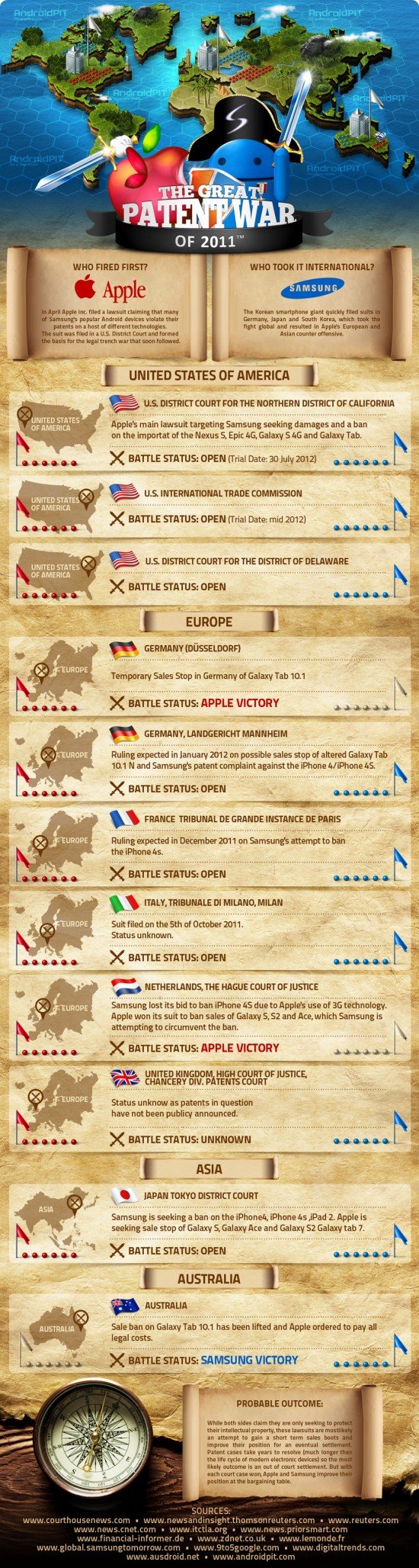
But things have not been going so well in the EU. Apple argued in
September in the Hague court that Samsung infringed its patent on
multi-touch functions, which lets users use two fingers at one time on a
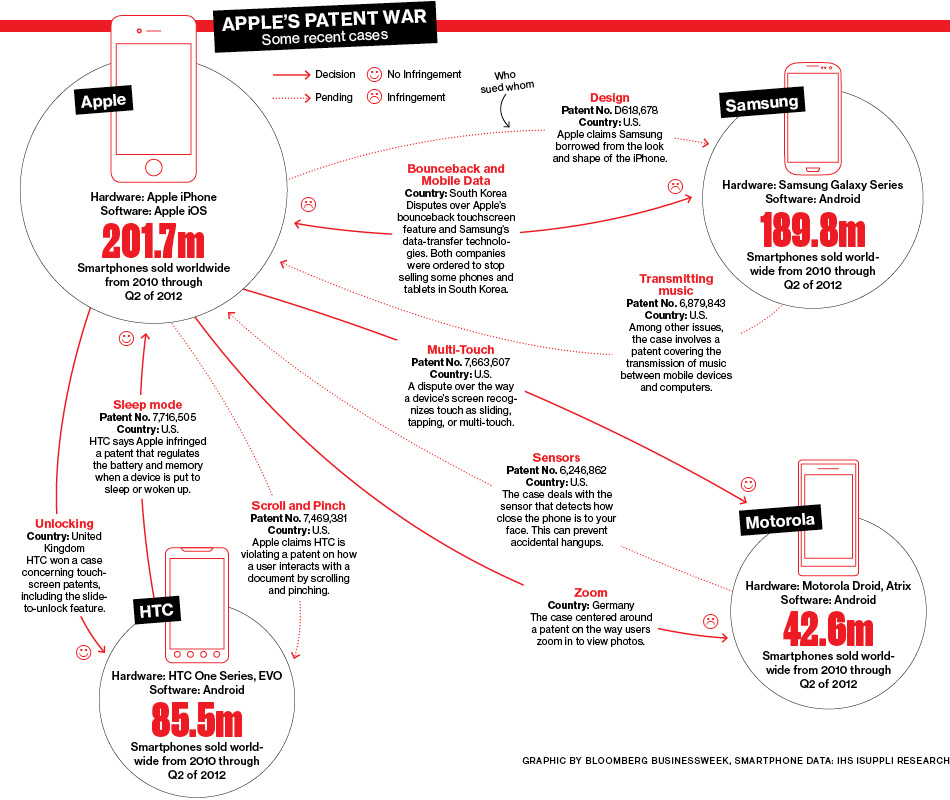
touch screen. Apple has taken Samsung to task over the "pinch to zoom"
function popular on smartphones and tablets.
Not only did it lose a preliminary injunction on this patent in the
Dutch courts last year it also lost its battle in the courts in Britain
against HTC, and in Germany against Samsung and Motorola Mobility, which is owned by Google.
The Dutch court said its multi-touch patent ruling was similar to those in Britain and Germany.
While this is a mess, it does not seem to actually mean anything.
Samsung can, and has, simply released new hardware in the US which does
not break Apple's patents. So far not a single top of the range
smartphone or tablet has been taken off the shelves in a way which would
commercially give any ground to either side. Products which are banned
are usually long gone after the appeals process is exhausted.
In other words the only side that is really winning in this battle are the lawyers.







Late last week, a San Jose
jury awarded Apple Inc. $1.05 billion in damages for patent
infringement, a huge win for Apple in its worldwide patent fight with
smartphone manufacturers that, like Samsung, sell devices equipped with
Google's Android operating system.
The award, the third largest in
the history of U.S. patent litigation, will likely cruise into first
place next month when U.S. District Court Judge Lucy Koh decides what
additional amount Apple should receive from Samsung based on the jury's
finding that much of the infringement was "willful."
But even
without that enhancement, which could add another $2 billion to
Samsung's tab, the jury's $1 billion-plus verdict breaks down to just
under $48 for each of the roughly 22 million infringing phones sold by
Samsung. To the jury, 50 bucks per phone must have sounded like a
reasonable figure, and it may well to you too.
But it's not — it's way too
high — and here's why: The average smartphone may arguably infringe as
many as 250,000 patents, not to mention myriad copyrights and other
design-related intellectual property. (Companies don't sift through
every patent coming out of Washington before engineering and releasing a
product; they create devices and battle claims as necessary.)
If
you were to divide the average retail price of a smartphone — about $400
— by those 250,000 potentially applicable patents, you'd find that each
one would account for just $0.0016 of the phone's value. And, in
reality, even that's too much, once you factor in the costs of raw
materials, labor, transportation and marketing, which also contribute to
a phone's value.
Yet for infringing just a handful of Apple's
patents, Samsung faces a minimum payment of $48 per phone, a shocking
30,000 times the average per patent value. Put another way, if the
owners of all the 250,000 inventions that might be present in Samsung
smartphones were awarded damages at the same level as Apple, Samsung
would have to charge a ludicrous $2 million per phone just to break
even.
But wait, you say, the San Jose jury no doubt included some
level of punishment in its award, in order to "send a message." But, by
law, patent damages are meant to compensate not punish, as the jury was
expressly instructed.
Or maybe Apple's patents are worth far more
than average intellectual property and are therefore deserving of a
higher rate? Perhaps so. But thousands of times more valuable?
For
that matter, why shouldn't we also entertain the possibility that
Apple's patents are actually worth less than the average? It may sound
blasphemous to question the value of intellectual property owned by the
world's most valuable company, but consider this: When purchasing a
phone are you willing to pay more for rounded corners and stylish icons
or for the device's ability to transmit data to a cell tower? In the
smartphone wars, Apple is primarily enforcing patents on the former,
Samsung and Motorola on the latter.
Surprisingly, Apple is well
aware of arguments about the real worth of each patent per phone: "In a
world where a device can be made up of thousands of patented components,
patent infringement damages should be proportionate to the value of the
component in question rather than the entire product." That's a 2008
quote from the Coalition for Patent Fairness, an advocacy group formed
by Apple and other tech companies frequently sued for patent
infringement.
Indeed, Apple makes this same point in some form or
fashion dozens of times a year when playing defense against patent suits
filed by other, much smaller patent owners. Over the last five years,
no company has been sued more times for infringement than Apple. When
the shoe was on the other foot, however, it was content to check its
patent law principles at the courtroom door: It actually asked for far
more than it received, about $2.5 billion total in "compensatory"
damages.
So, Apple, congratulations on your large award. Next time
you're accused of patent infringement by a start-up, an individual
inventor or a dreaded "patent troll," I'm sure you'll be flattered when
the patent owner uses your own damages calculations against you.
Actually, on second thought, here's betting you won't like it much at
all.
Brian J. Love is an assistant professor of law at Santa
Clara University School of Law, where he teaches courses in patent law
and remedies.


