Wednesday, 26 September 2012

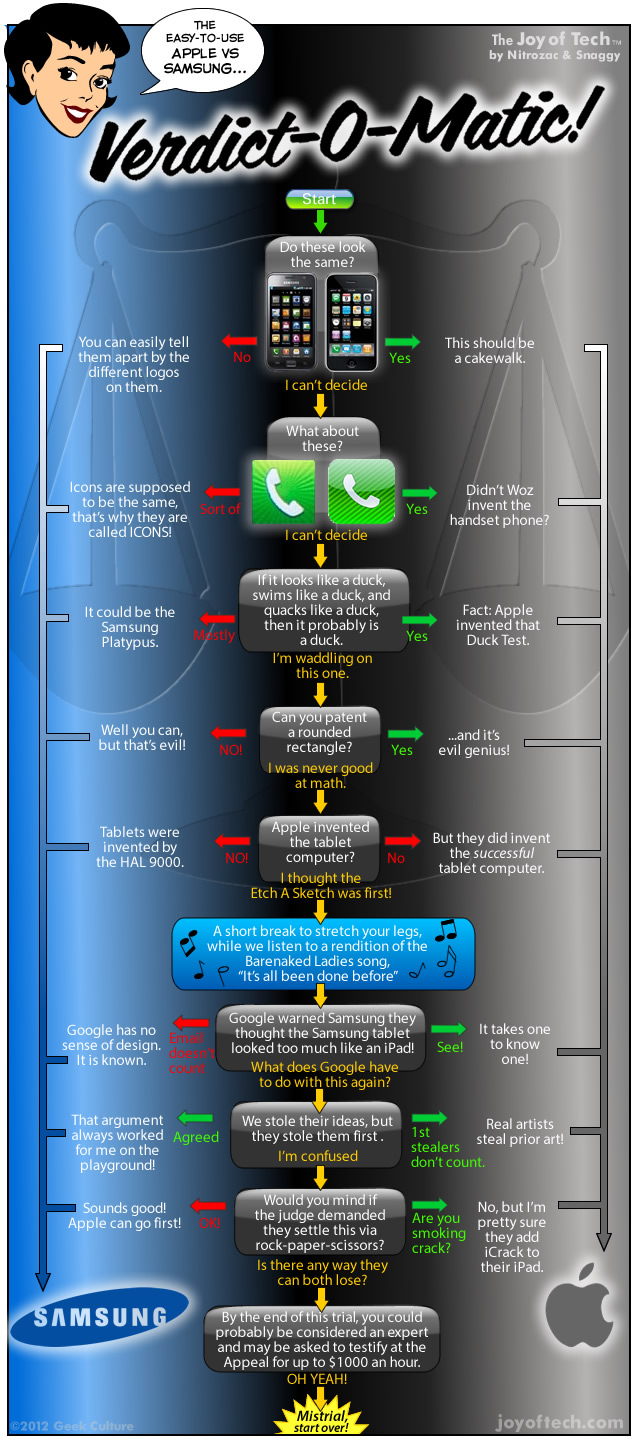
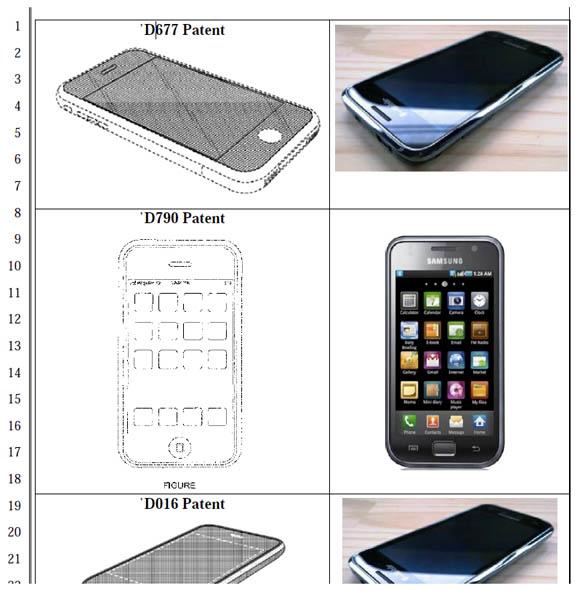
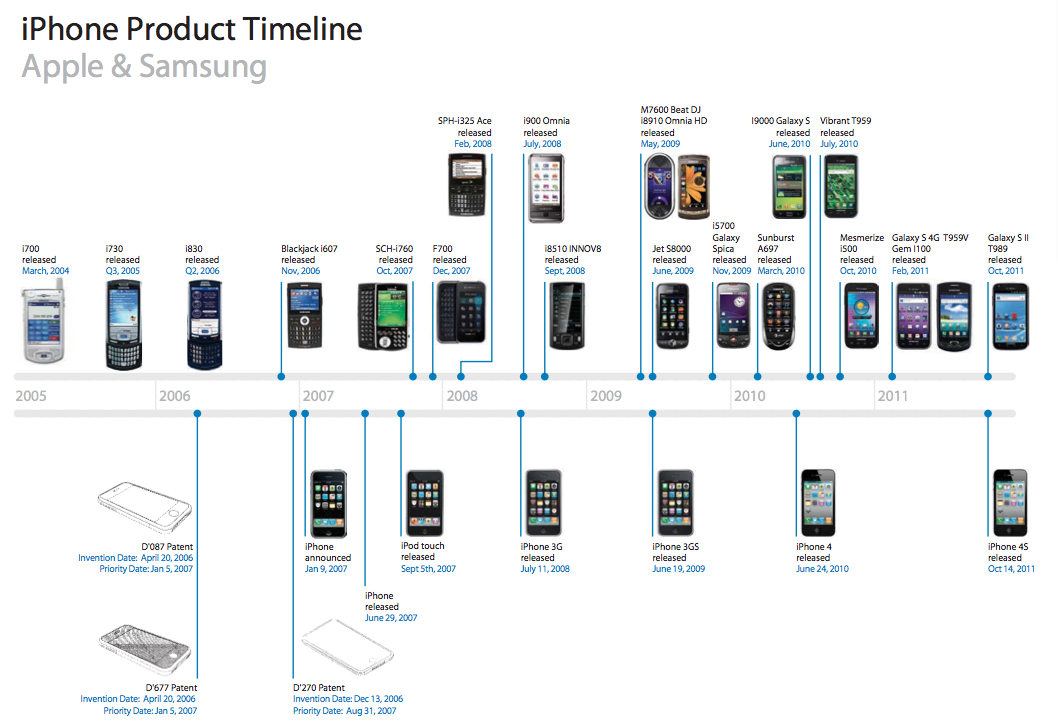
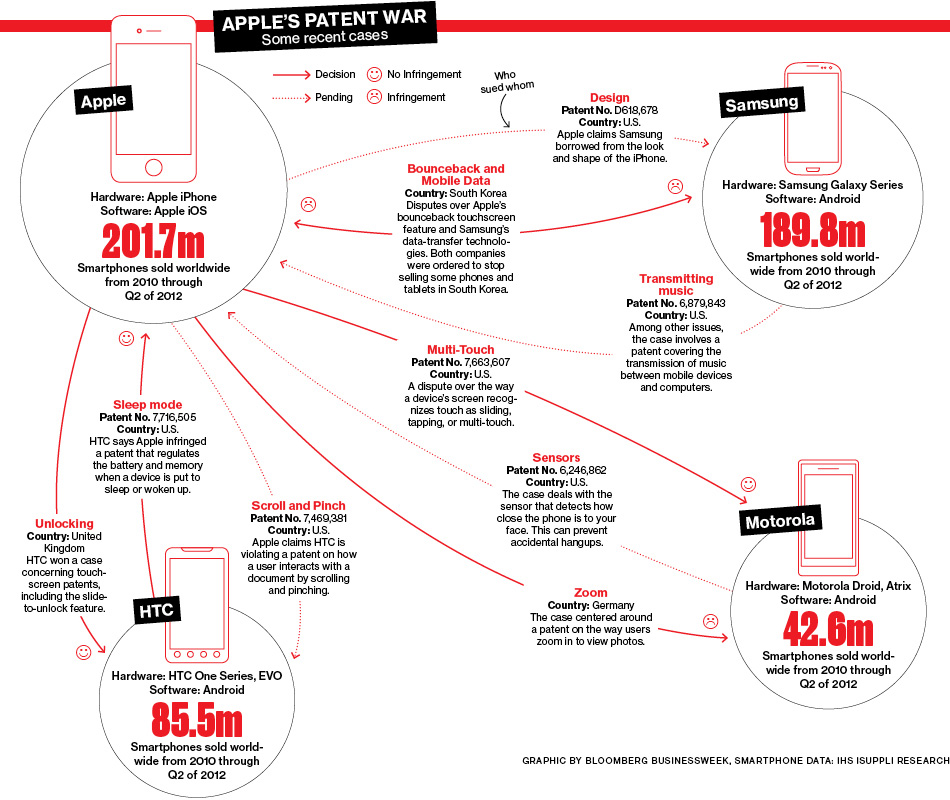
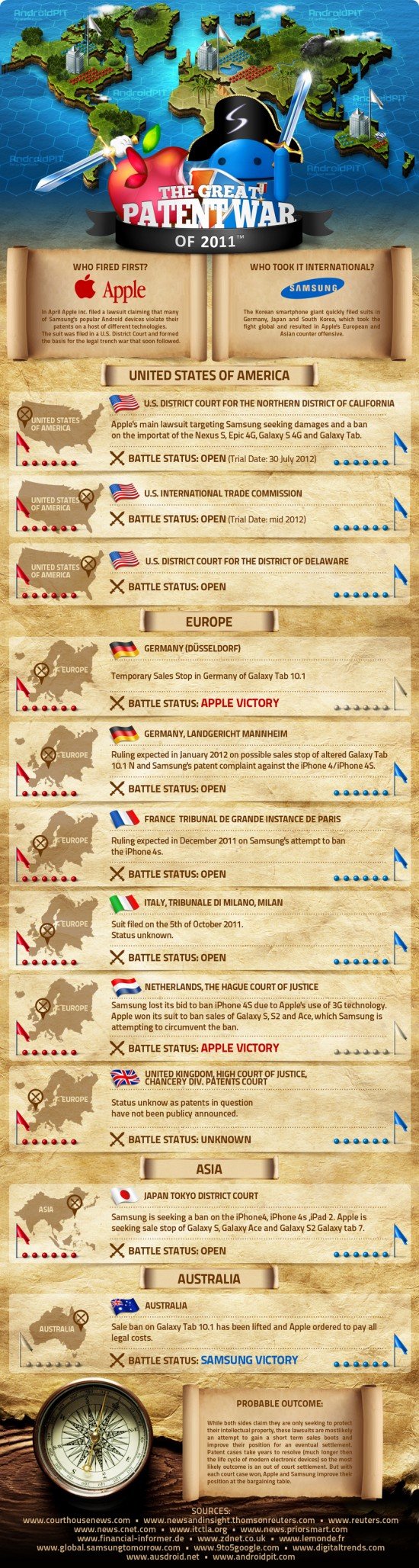
Apple vs Samsung patent war explained on 8 infographics

The easy to use Apple vs Samsung guide

http://www.geekculture.com/joyoftech/joyarchives/1729.html
T-Mobile “Sides” With Samsung In Apple/Samsung Patent War

http://www.tmonews.com/2011/09/t-mobile-sides-with-samsung-in-apple...
Apple vs. Samsung: The Patent Wars, Explained

http://mashable.com/2011/11/23/apple-samsung-patent-wars/
Apple Vs. Samsung Patent War

http://www.teluglobe.com/tg-roundup/apple-vs-samsung-patent-war
Apple vs Samsung Trial Patent Case: Apple Wins, $1Billion Awarded To Apple

http://icydiablog.com/web/apple-vs-samsung-trial-patent-case-apple-...
Apple's patent war: some recent cases

http://www.iphoneincanada.ca/iphone-news/apples-patent-war-some-rec...
Apple’s Patent Claims

http://blog.thomsonreuters.com/index.php/apples-patent-claims-graph...
Getting Your Head Around the Patent Wars


http://www.applegazette.com/news/getting-your-head-around-the-patent-wars/

Where To Find Books About Intellectual Property

Where can one find the best recommendations for recent books on intellectual property?  I’m on the constant lookout for the answer to this question. I get some of my recommendations directly from the left sidebar of this blog, such as the must-read book Patent Searching: Tools & Techniques, edited by David Hunt, Long Nguyen, and Matt Rodgers. I find other useful book reviews and notices through a number of popular IP blogs, such as IPKat and PatentlyO.  I also use other common resources, such as Amazon, GoodReads, and WorldCat, to locate lists of recent intellectual property books (and find out where I can borrow or buy them).
Continue reading to learn some of the techniques I use to find interesting new books about intellectual property topics, and share your suggestions on where I can locate the best IP books!
IP Books on Blogs
Blogs are excellent resources for locating recently released IP books and getting in-depth reviews by patent and IP law experts.  Here are just a few of the intellectual blogs that regularly publish book reviews:
  • PatentlyO – This popular patent law blog occasionally publishes detailed reviews on books dealing with various intellectual property and patent law issues.  The last post under the Book Review tag was published in October 2011, but continue to keep an eye on this blog for the occasional book review.
  • IPKat – The IPKat blog posts book notices on a fairly regular basis, usually every few months, and these posts often recommend two or three books revolving around a single intellectual property topic, such as trade secrets.
  • Patent Baristas – The Patent Baristas sometimes add to their ongoing series of Book Review Mondays, when they post a lengthy review on a recently published book in the intellectual property field.  The books suggested in these reviews often provide broad overviews on general IP topics, and these recommendations will be useful for readers new to the IP field.
Also check out of side bar of this blog for book recommendations on the topic of patent searching and patent law.
IP Bookshelf on GoodReads
Goodreads is more suited to locating fiction books for casual reading, but the site does offer an Intellectual Property bookshelf of about 150 books that cover an eclectic range of topics, including many books on copyright and trademark issues.  Select a book from the list to for a full-record view that includes bibliographic data and a summary of the book, where the book can be bought through various online stores (as well as a link to WorldCat), and multiple user reviews and ratings.
IP Books on Amazon
Amazon.com offers a detailed hierarchy of book subjects which users can browse, and the user can drill down to the subject of Intellectual Property (under the Law category).  The Intellectual Property section of Amazon.com allows users to sort through over 10,000 books by format (paperback, hardcover, Kindle, or audio edition), and users also have access to a sidebar with additional filtering options, such as release date, author, book series, language, or customer rating.  Amazon also offers a page that lists best sellers in Intellectual Property Law.
Intellectual property books listed on Amazon.com.
Searching WorldCat for IP Books
WorldCat is a search system provided by OCLC Libraries that can search content from over 10,000 libraries and includes 1.5 billion items, so you can use this resource to locate books on the subject of IP law in libraries around the world.  Select the Books search option and enter the query “su:Intellectual property” to search for books under the subject of intellectual property.  You can then use the sidebar on the results page to filter by publication year, language, additional topics, etc. Select a result to view the full record for the book, including a list of libraries where the book is available.
Intellectual property books on WorldCat.

The Latest Updates from Knovel: New Database, Engineering Subject Area, and Excel Tool

As an online subscription portal created to provide technical information for scientists and engineers, Knovel can also be harnessed by prior art searchers looking for reference information on engineering and technology topics. Knovel, originally launched in April 2001 and maintained by the Knovel Corporation, is a subscription-based online platform that provides access to more than 4,000 reference works and databases from over 90 international publishers and professional societies. Knovel focuses on engineering content, and and it currently covers 30 subject areas.  According to its website, the Knovel interface also provides access to “interactive tables and graphs to help engineers use and export relevant data.”  Through the Major Recent Updates section of the Knovel System Report on Intellogist, you can read about the latest changes to Knovel’s content coverage and interface.  The Knovel system has seen a number of updates during the month of September, including a new Titanium Alloy Database, a new subject area covering Fire Protection Engineering and Emergency Response, and an Excel Add-In which users can download to integrate the Knovel search and unit converter tools into their Excel worksheet.
After the jump, learn more about these September updates to Knovel!

The following updates were announced on the Knovel website and K-Exchange Blog in September 2012:
Titanium Alloy Database – A Knovel press release describes the new Titanium Alloy Database added to its Critical Content line:
The Titanium Alloy Database, developed by J. Gilbert Kaufman, includes physical and mechanical property data for more than 80 alloys, with summarized descriptions of condition and processing history. Compelling features of this new database include:
  • High temperature properties information such as strength and fracture data at high temperatures;
  • An extensive list of often used properties of titanium alloys including the alpha, alpha-beta and beta type alloys;
  • Typical applications and available product forms for numerous alloys.
Fire Protection Engineering Subject Area – A press release on the Knovel website describes the newest subject area, Fire Protection Engineering and Emergency Response, released on the platform:
Knovel’s Fire Protection Engineering and Emergency Response Subject Area provides over 70 titles covering a wide range of information, including:
  • Fire Protection Analysis
  • Fire Protection Management
  • Fire Science & Human Behavior
  • Fire Protection Systems
  • Passive Building Systems
Key publishers in the new subject area include John Wiley & Sons, PennWell, ASHRAE, ICHemE, Elsevier, AWWA, Steel Construction Institute/FABIG, US CDC, American Society of Plumbing Engineers and Smithers-Rapra.
Excel Add-In -According to the K-Exchange Blog, Knovel now has a new Excel Add-In which “installs a tab to your Excel desktop that provides one-click access to Knovel’s search and unit conversion tools. When you login at www.knovel.com you’ll find the Excel Add-In under the tools menu.” The add-in installs a Knovel tab into Excel worksheets, and users have direct access to:
  • Knovel’s search
  • Data search
  • Unit conversion
The Knovel Excel Add-In (screenshot from K-Exchange blog post).
 Conclusion
The Knovel System Report on Intellogist comments thatKnovel is a useful resource for scientists and engineers looking for access to detailed technical reference material. Knovel is also helpful for prior art searchers looking to understand basic concepts in engineering and technology, but its helpfulness as a prior art source is debatable. Searchers looking for a broad swath of the most up-to-date publications and journal articles in a particular technical area will probably not find Knovel useful. However, for its intended purpose, Knovel can be useful to gain background knowledge on the theory behind technology areas that a prior art searcher must be familiar with.  The subject areas covered by Knovel are expanded on a regular basis, as illustrated in the Major Recent Updates section of the System Report, and Knovel also seems to be growing its Critical Content line of databases every few months. Knovel is a growing online resource for engineers and scientists that can also serve prior art searchers for educational and reference purposes, so check out the Knovel System Report to learn more about the platform!

Tuesday, 11 September 2012

Free Chinese Patent Search System Comparison

Over two years ago, the Intellogist Blog discussed Chinese patent searching on a budget. The free search options for Chinese patent documents included in that post were SIPO, CNIPR/C-Pat, CNPAT, Surf IP and IPEXL. We later published a post on the free Chinese patent search options on  Zhihuiya.com. Over the past two years, these websites have all undergone many changes, and some of the search systems are no longer freely available.  Surf IP and C-Pat are no longer available online, and  Zhihuiya.com is now redirected to CN.Patsnap.com, which only appears to be available for subscribed users.  Continue reading to learn about the free Chinese patent search options currently available through the remaining search systems: SIPO, CNIPR, CNPAT, and IPEXL (which draws on SIPO data).  If you need a global prior art search conducted by a professional searcher fluent in Chinese, you can always contact patent search professionals who have access to both free and subscription patent databases with broad Chinese patent coverage.
After the jump, learn about the free Chinese patent search options available through SIPO, CNIPR, CNPAT, and IPEXL!
SIPO
The State Intellectual Property Office (SIPO) of the PRC (People’s Republic of China) offers a free English patent search interface for invention and utility models.
The search will be conducted on English-language titles and abstracts in the collection. Users can also produce a full text machine translation of individual documents. The machine translation technology, called the China Patent Machine Translation system (CPMT), was researched and developed by China Patent Information Center.
Users can access the patent search system through the SIPO English-language homepage by selecting the “Patent Search” link in the menu bar on the right side of the page. Users can select to search within the Invention or Utility Model databases (or within both). Users enter queries within multiple fields by utilizing the top half of the site to search by Publication Number, Publication Date, Application Number, Application Date, Title, Abstract, IPC, Applicant, Inventor, Patent Agent, Patent Agency Code, Priority, and Province/Country Code. Users can also enter queries in the Combination Search at the bottom of the page, where they can search within multiple fields, use parentheses, and join search terms by Boolean operators. A guide for correctly formatting search terms and allowable operators is found under “Help.”
Users can choose to sort their results by any field listed in the “Sort By” drop-down menu at the top of the search page, in ascending or descending order.
When users select a result from the record list to view, they will first be taken to a bibliographic record of the patent document. Users can view a machine translation of the full document by selecting “Machine Translation” at the bottom of the page. Upon first selecting the “Machine Translation” button for a particular record, an English-language translation of the claims will be displayed. To see the rest of the specification, users should scroll to the bottom of the page and select the “Description” button.
The EPO website provides guidance on how to utilize other free search tools provided by SIPO:
The English-language bibliographic data for a Chinese patent record on the SIPO website.
CNIPR
China Intellectual Property Net (CNIPR) is a platform for Chinese patent searching, monitoring, document translation, document delivery, and Chinese Pharmaceutical patent searches, maintained by the Intellectual Property Publishing House (IPPH). The free Chinese patent search platform C-Pat is no longer available through CNIPR, but users can subscribe to an English-language version of CNIPR.  See this page on the English version of the CNIPR website for pricing information.
Users can still search for Chinese patent documents on the Chinese-language version of the CNIPR website for free. The EPO provides a step-by-step guide on retrieving Chinese documents from IPPH/SIPO’s CNIPR database. A fielded search form (in Chinese) allows users to search for Chinese patents, utility models, designs, granted patents, TW patents, and HK patents (as of September 2012, additional authority coverage appears to be available).  The full record displays bibliographic data, abstract, main claim, legal status, citations, patent family, and automated abstract/keywords. The EPO guide indicates that users can download the document in TIFF format, when available.
A Chinese-language record on CNIPR.
CNPAT
China Patent Database (CNPAT) is a free online search platform for Chinese patents, patent applications, utility models, and designs, created by the China Patent Information Center.  A majority of the interface only is available in Chinese, although users can view the fields for the advanced and expert search forms in English.  The site includes a quick keyword search form (Chinese only), a fielded search form (field labels available in English), and a command line interface (field labels available in English). Users can choose to included thumbnail images in the search results (which are only viewable in Chinese). The full record may include bibliographic data (including the first claim, when available), drawings, the full-text PDF, full claims, and legal status. It appears that a translation service is available for title, abstract, and first claim for “VIP Users Only.”
A Chinese-language record on CNPAT.
IPEXL
Users can create a free account to log in to IPEXL (maintained by the Intellectual Property Exchange) and search through the following collections for free: US, US applications, China (native), and Singapore. The CN patent collection includes Chinese-language patent data only, available through SIPO.  A fielded form allows users to search through a variety of fields (abstract, title, inventor, attorney, agency, applicant/assignee, IPC, etc.), and users can also limit the search by document number, publication data, application date, and patent type. The list of search results and full document records include basic bibliographic information in Chinese (title, inventor, applicant, attorney, abstract, IPC, document number, publication date. application date, etc.). Users can view the original source of the data on the SIPO website, create a permanent link to share the record, or create a graph of citation relationships for the record.
A Chinese-language record on IPEXL.
Conclusion
All Chinese patent search data originates from SIPO, although each website’s search interface provides a different user experience.  While English translation options on CNIPR and CNPAT are only available for subscribed users, both SIPO and IPEXL offer a free English search interface (although users on IPEXL must use Chinese-language queries).  English-language users will probably have the easiest time utilizing the SIPO English-language search interface, since the user can enter queries in English and create full English-language machine translations for patent records.  The SIPO website also provides additional free services (in Chinese), such as legal status search and file history information.
Although English-language patent searchers may be able to conduct a basic initial search of a portion of SIPO’s Chinese patent collection using the machine translation services on the SIPO website, there is no substitute for a native-language searcher when conducting a comprehensive prior art search.  Always contact a patent search professional who is fluent in Chinese and has access to global patent and non-patent literature search systems if you need a patent search for business or legal purposes.
Do you know of other free Chinese patent search options?

A Patent Analysis Tool For Merging Assignee Names in TotalPatent Charts

The semantic search option on TotalPatent is a unique tool for patent searchers. so today I’d like to call attention to a new TotalPatent feature created specifically for patent analysis purposes: the Merge tool. TotalPatent includes an Analytics tab where users can create charts using saved datasets from search results, folders, or document retrieval results.  Users can now normalize the fields displayed in the charts by manually combining specific data points using the Merge tool.  This tool will be useful to patent professionals performing initial analysis of a patent dataset because users can merge equivalent assignee or inventor names and therefore generate a more accurate visualization of the dataset.  The visualization and data cleaning tools on TotalPatent are very simple and are no substitute for detailed patent landscape studies. The charts created under the TotalPatent Analytics tab shouldn’t be used to make important business or legal decisions, but they will provide an initial overview on certain aspects of the dataset through a simple visualization.
Continue reading for a closer look at how to use the Merge tool on TotalPatent can be used to combine equivalent assignee names!
Using the Merge Tool
The analysis functions on TotalPatent may be performed on either a search result set of up to 3,000 or a Work Folder set of up to 20,000 patent records. The analysis features are initiated by choosing the Analyze option above the results list or the Work Folder list. Users can also access the analysis section directly by choosing the Analytics tab in the top horizontal menu. Select the Visualize option in the submenu below the Analytics tab to view the interface for generating charts from patent data sets. Users can choose from a wide range of fields to include in the chart (authority, kind code, inventor name, assignee name, normalized assignee, publication date, filing date, etc.), and possible chart selections include simple line, bar, stacked bar, column, pie and bubble charts. Once the analysis charts have been created, they are interactive: a user may select a particular data point of interest, which will begin to flash. A list of all individual patent documents contained within that data point will then appear below the chart, where they can be viewed in more detail.

As of March 2012, a new Merge tool was added to the Analysis platform on TotalPatent, and users can select the “Combine Items” link at the top of the chart to manually normalize data fields such as Assignee Name, Inventor Names, Classes, etc. After selecting the “Combine Items” link, users will be presented with a window where they can select from all available data points for each field.


The user can select multiple data points representing the same item, such as multiple assignee names representing the same company. The user then must enter a new name for the combined items (such as “Agilent” to represent the three merged assignee names in the screenshot below), and the user can also specify whether this combination should be applied automatically to all analysis charts for this data set from this point forward.
After you select OK, the Merge window will close, and the combination will automatically be applied to the analysis chart. The user can choose to undo the last combination or edit the combination settings. When a user mouses over a section of the chart that represents a set of merged data points, the label that appears will display the newly assigned name for all merged data points, with the individual data point names listed below.

Mouse over a merged section of the chart to view all combined data points.
How Useful is the Merge Tool?
The visualization options in TotalPatent are greatly improved by the Merge tool, since users can create more accurate representations of the data by merging equivalent data points within a field.  For example, equivalent assignee names that weren’t merged initially through the normalized assignee field can be combined manually using the Merge tool.  The Merge tool is a step towards a more accurate and advanced analysis module on TotalPatent, but this merge option is still very basic when compared with the advanced data cleaning functions on data analysis platforms like VantagePoint.  The limited data cleaning and chart options on the TotalPatent analysis module will at most be useful as a first step during in-depth patent analysis projects. The chart tool can still be used for initial overview purposes, though, to visualize trends in smaller patent data sets.

Thursday, 6 September 2012

Reverb Networks Awarded Patent for SON-based Interference Detection

Advanced Techniques Used in Automated SON Solutions

Sterling, VA (PRWEB) September 06, 2012
Reverb Networks, a leading developer of intelligent Self-Optimizing Network solutions designed to provide mobile network operators with improved operational and spectral efficiencies, announced today that it has received a patent award from the US Patent and Trademark Office for automated interference detection techniques using measurements from mobile devices, a key component of SON-based network optimization for UMTS and LTE wireless networks.
Reverb’s interference detection patent, USPTO number 8,229,363, follows the Minimization of Drive Test (MDT) principle identified in emerging 3GPP technical specifications. Interference sources are typically identified in mobile networks by using test mobiles and receivers in an orchestrated drive test setting, a process that is both time consuming and labor intensive. Motivated by the MDT principles of automating data collection from OSS and standard device-based measurements, Reverb’s intellectual property outlines a method of identifying and ranking interference sources. These techniques are incorporated in the Interference Reduction feature of Reverb’s InteliSON®, a fully automated, closed-loop SON solution.
“The interference detection patent award bolsters Reverb’s IPR portfolio in SON technology,” said Magnus Friberg, CEO. “This award, combined with our other issued and pending patents, demonstrates Reverb’s unique technology for automating network optimization with our InteliSON platform. We will continue to drive innovation in SON technology as we further deploy our leading edge solutions in 3G and 4G networks worldwide.”
About Reverb Networks
Reverb Networks is a pioneering provider of automated, continuous and antenna-based Self-Optimizing Networks (SON) solutions. Reverb’s InteliSON enhances networks of Mobile Network Operators through frequent and proactive self-optimization that improves network coverage and capacity and increases spectral efficiencies. In partnership with Reverb Networks, operators can maximize the performance of their wireless network automatically and efficiently, resulting in lower OpEx and CapEx. Reverb’s SON applications include for Load Balancing, Interference Reduction and Self-Healing for both UMTS and LTE network technologies.
Headquartered in the United States, Reverb Networks has presence in the Americas, Europe, Middle East, and Asia, and offers support across the globe

Thursday, 30 August 2012

Apple-Samsung patent fight

The average smartphone may arguably infringe as many as 250,000 patents. A jury award of $1.05 billion vastly overstates the real worth of each patent.


Late last week, a San Jose jury awarded Apple Inc. $1.05 billion in damages for patent infringement, a huge win for Apple in its worldwide patent fight with smartphone manufacturers that, like Samsung, sell devices equipped with Google's Android operating system.
The award, the third largest in the history of U.S. patent litigation, will likely cruise into first place next month when U.S. District Court Judge Lucy Koh decides what additional amount Apple should receive from Samsung based on the jury's finding that much of the infringement was "willful."
But even without that enhancement, which could add another $2 billion to Samsung's tab, the jury's $1 billion-plus verdict breaks down to just under $48 for each of the roughly 22 million infringing phones sold by Samsung. To the jury, 50 bucks per phone must have sounded like a reasonable figure, and it may well to you too.
But it's not — it's way too high — and here's why: The average smartphone may arguably infringe as many as 250,000 patents, not to mention myriad copyrights and other design-related intellectual property. (Companies don't sift through every patent coming out of Washington before engineering and releasing a product; they create devices and battle claims as necessary.)
If you were to divide the average retail price of a smartphone — about $400 — by those 250,000 potentially applicable patents, you'd find that each one would account for just $0.0016 of the phone's value. And, in reality, even that's too much, once you factor in the costs of raw materials, labor, transportation and marketing, which also contribute to a phone's value.
Yet for infringing just a handful of Apple's patents, Samsung faces a minimum payment of $48 per phone, a shocking 30,000 times the average per patent value. Put another way, if the owners of all the 250,000 inventions that might be present in Samsung smartphones were awarded damages at the same level as Apple, Samsung would have to charge a ludicrous $2 million per phone just to break even.
But wait, you say, the San Jose jury no doubt included some level of punishment in its award, in order to "send a message." But, by law, patent damages are meant to compensate not punish, as the jury was expressly instructed.
Or maybe Apple's patents are worth far more than average intellectual property and are therefore deserving of a higher rate? Perhaps so. But thousands of times more valuable?
For that matter, why shouldn't we also entertain the possibility that Apple's patents are actually worth less than the average? It may sound blasphemous to question the value of intellectual property owned by the world's most valuable company, but consider this: When purchasing a phone are you willing to pay more for rounded corners and stylish icons or for the device's ability to transmit data to a cell tower? In the smartphone wars, Apple is primarily enforcing patents on the former, Samsung and Motorola on the latter.
Surprisingly, Apple is well aware of arguments about the real worth of each patent per phone: "In a world where a device can be made up of thousands of patented components, patent infringement damages should be proportionate to the value of the component in question rather than the entire product." That's a 2008 quote from the Coalition for Patent Fairness, an advocacy group formed by Apple and other tech companies frequently sued for patent infringement.
Indeed, Apple makes this same point in some form or fashion dozens of times a year when playing defense against patent suits filed by other, much smaller patent owners. Over the last five years, no company has been sued more times for infringement than Apple. When the shoe was on the other foot, however, it was content to check its patent law principles at the courtroom door: It actually asked for far more than it received, about $2.5 billion total in "compensatory" damages.
So, Apple, congratulations on your large award. Next time you're accused of patent infringement by a start-up, an individual inventor or a dreaded "patent troll," I'm sure you'll be flattered when the patent owner uses your own damages calculations against you. Actually, on second thought, here's betting you won't like it much at all.
Brian J. Love is an assistant professor of law at Santa Clara University School of Law, where he teaches courses in patent law and remedies.


Wednesday, 22 August 2012

Apple granted patent for ad-skipper

LOS ANGELES (TheWrap.com) - Another front has opened in the attack on commercials.
Apple received a patent Tuesday for technology that would allow users to switch seamlessly to their own audio or video files once ads started playing on their TV or radio.
Unlike Dish Network's Auto Hop feature that allows users to bypass ads, with the Apple device, a user's iTunes library would kick in and play music, video or a podcast.
As for Apple's plan, according to the patent approved by the U.S. Patent and Trademark Office: "When an electronic device determines that an upcoming media item in a media broadcast is not of interest to a user, the electronic device can switch playback from the media stream to a media item from the electronic device local library," the patent said.
The networks are not likely to be happy. CBS, Fox and NBC already have filed lawsuits against Dish, saying Auto Hop is illegal and reduces the advertising revenue the networks depend on to purchase programming.
The feds granted the tech titan the new patent just a week after clearing the way for Apple to create a TiVo-like box that would allow the recording or pausing of live television.
The new patent seems to increase the speculation surrounding a revamped, broadcast-integrated Apple TV.
It also could impair talks Apple is currently having with top network executives to negotiate a deal that could bring live television to Apple TV, limited at first to streaming services like Netflix, Hulu or iTunes rentals.
AppleInsider was the first to report on the patent.

Latest Filings and Granted Patents Of Major Industries

Latest Filings and Granted Patents Of Major Industries

The above link will lead you to the latest filing and granted patents of some major Industries at a glance look............

Wednesday, 15 August 2012

Google’s “Prior Art Finder”

Google’s “Prior Art Finder”

Google announced a major update to their Google Patents search tool yesterday. These changes include two main offerings:
1. The inclusion of EP documents
2. The introduction of the “Prior Art Finder” tool
As of the writing of this blog post, it appears that while EP documents are available within the Google Patents search system (such as this document), they do not come up normally in results lists for search queries. This is the case even when using verbatim title searching or document number searching, and the advanced search form does not include any options for searching EP documents, either. However, this seems like a glitch or gradual roll-out that Google is well known for and not a permanent issue. The inclusion of EP documents is a major boon to those who prefer Google Patents over Espacenet (in the free search tool domain). EP data is but the first step towards making Google Patents a more viable search tool for more than a quick starting point or “silver-bullet” type search.
As for the Prior Art Finder tool: I’ve got a lot to say about how that feature works, what it can do for the professional searcher, and what it means for the future of prior art search after the jump.

Google’s Prior Art Finder tool is accessible from any individual patent document within Google Patents’ system.
Prior Art Finder pros
1. Query generation is automatic – Starting a query with the Prior Art Finder couldn’t be easier. Users need only to click the blue “Find prior art” button at the top of any individual patent document within Google Patents. From there, search terms are automatically mined and generated from the full available text of the document. Accompanying the term generation is an automatic end date for search results that coincides with the extracted filing date from the patent document (putting the “prior” in prior art).


2. Federated search through various Google entities is helpful – Users accustomed to running separate strings in Google Scholar and Google Books will be assisted by the fact that both of these valuable search tools will be queried simultaneously through the Prior Art Finder. Switching between results sets is accomplished by selecting the category at the top of the results page, and the pre-loaded entries load instantaneously and conveniently.
3. Post search modification is user-friendly – Automatically generated search terms are clearly displayed (no black-box here!). Along with supplementary generated terms, can be toggled on-and-off with ease and search results will be instantly updated. Additionally, the custom date range fields can similarly be modified.

 Prior Art Finder cons
1. Results are limited to Google search engines – Prior Art Finder merely searches Google Scholar, Google Patents, Google Books, Google People, and Google Web. It will not search valuable prior art databases that Google does not have the access to index, ruling out a vast majority of the available “non-patent” prior art available to expert searchers. As a result, those seeking a complete professional prior art search will find that Prior Art Finder is merely a first drop in the bucket.


 2. Queries must be generated from a document present in Google Patents’ database – This means if it’s not a US or EP document in Google’s database, you’re out of luck for automatic query generation. There is no currently available easy way to create your own query, but a work-around can be accomplished by using any patent document in the Google system as a starting point, erasing the automatically generated terms, and entering your own. At this point, however, users may be better suited to generate their own queries in each separate Google search product. At the same time, it would be nice to have the interface of Prior Art Finder and the functionality of the federated nature of the tool available for brand new queries.

 3. Automatic query generation and results are hit-and-miss – Testing on a patent for a “Thread-measuring feeding device” came up with results for yarn properties, blood regulation, human motion analysis, fly fishing, and computer threading (and this was just in the “Top 10″). At this stage, Prior Art Finder is far from a panacea for those looking for the next evolution in automated prior art search. It just goes to show that the “neck-top computer” still can’t be beat when it comes to complex and semantic heavy problems such as patent and prior art searching.


 One further note: the Google Research blog post about this update leads me to believe that many further updates may be coming to Google Patents. One can only hope that the sleeping giant in the search field has been awakened to the possibilities and growing necessity of providing patent search tools!


The Patent Family Tree tool (PFTT)

Claim Set Comparison... Tool

Claim Set Comparison Tool
Ever wondered how the claims changed between the published application and the issued patent? Frustrated with figuring out the difference between the U.S. claims and the foreign counterpart claims? This handy tool compares two sets of claims and highlights the difference between them. The comparison chart can be displayed in a new browser window or downloaded as a word or excel file. 


Patentfish.com... A new Patent search tool

A new EPO classification scheme for climate change mitigation technologies

Climate Change Mitigation Technologies (CCMTs) are becoming increasingly more important, both politically and economically. Having recognized this, the EPO cooperated with the United Nations Environmental Program (UNEP) and the International Centre on Trade and Sustainable Development (ICTSD) and produced a study on Patents and Clean Energy. To consolidate the efforts invested in this study, the Y02 patent classification was created. This is a tagging scheme developed by experienced examiners working in the relevant fields, in cooperation with external experts, for patent documents related to CCMTs, which provides additional classification next to the regular ECLA and IPC classification of such documents. Patent documents were tagged by means of search strategies by experienced expert examiners, which were formalized into algorithms that can be re-run periodically to update the classes. Currently there are 2 subclasses: Y02C (for Greenhouse gas capture and storage) and Y02E (CCMTs relating to energy generation, transmission or distribution). At the time of writing, over 650,000 documents have been tagged with Y02 codes. A comparison between published patent documents with Y02 tags and published patent documents in general confirms that over the last 15 years the annual amount of patents related to “clean energy” has grown more than twice as fast as the average of all patents. The Y02 codes are available and searchable through Espacenet or PATSTAT.http://www.sciencedirect.com/science/article/pii/S0172219011001979

Intellectual property rights squabble erupts in industry group

The little-known industry group Certification Authority Browser (CA/B) Forum is suddenly becoming better known, as the bickering of the powerful companies associated with it gets louder as they squabble over intellectual property rights, part of a process in redefining how the group functions.
CA/B Forum, which takes up complex technology issues associated with public-key infrastructure (PKI) and digital certificates, a few years ago came up with what's called the "Extended Validation certificate," which requires a much tighter verification process to prove the identity of the entity requesting the certificate. That was certainly a crowning achievement. But since August, CA/B Forum, comprised mainly of browser makers and CAs that issue certificates, has melted down from 49 to 33 members as only those companies willing to sign off on the intellectual property rights (IPR) agreement document the group devised are allowed to stay on as members.
RELATED: New NIST encryption guidelines may force feds to replace old websites
According to members quarrelling over it, the new IPR document basically stipulates that members must disclose all patents related to PKI and digital certificates they have in order to retain the right to claim licensing royalties for any technologies the CA/B Forum comes up with in the future around it. In other words, the idea is put your cards on the table before new technology gets developed.
"Legally, we can't comply with it," Jon Callas, chief technology officer at Entrust, says about the IPR document. Entrust felt it had to resign from the CA/B Forum because its internal legal department couldn't approve the CA/B legal document it was asked to sign.
The problem, according to Callas, is that Entrust, privately owned by private equity firm Thoma Bravo, can't make assurances about everything affiliated with the private-equity firm, much of which it might not even know about. Entrust, a founding member that played a big role in creating the EV certificate, "wants to be involved" in the CA/B Forum, Callas says.
Besides Entrust, other companies known to have resigned their memberships include IdenTrust, RSA, RIM and Verizon Cybertrust. These declined to sign the IPR agreement, acknowledges Dean Coclin, senior director of business development at Symantec. He says T-Systems, based in Germany, had also balked at the IPR agreement but now appears likely to sign it.
Symantec is believed to have about 38% global share of the general SSL certificate market, and about 65% of the EV certificate market; for its part, Entrust is believed to have 1.2% and 2.47% respectively, according to Netcraft. The year-over-year overall market growth in SSL certificates is said to be more than 20%, with the EV certificate market growing at about 33%.
"We all want Entrust back in the Forum," says Coclin. "They had a problem with the way 'affiliate' is defined." He adds that an attempt at reconciliation is being made. Entrust had chaired the group, but with the departure of Entrust, the group now has two acting co-chairs, Symantec and DigiCert.